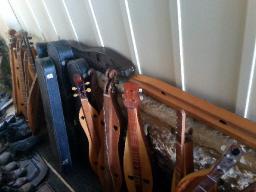
Hanging some dulcimers as a wall display
General mountain dulcimer or music discussions
Well said, John.
No problem. The violin uke appears to have zither tuning pegs which the Marx company probably used by the millions. It appears to be in fairly good condition.
Ken
"The dulcimer sings a sweet song."
Just throwing in my 2 cents of cynicism...{meant with goodwill and humor]
The absolute best display you can find for an extra dulcimer, is on the lap of a youngster that wants to play.
Un-played old dulcimers, regardless of maker or quality of craftsmanship are just dusty pieces of wood. They have perceived
value to an ever shrinking [dying] pool of us old hippies, in the memories of times past. The actual cash value is only when
they are sold, and that is "usually" at the death of the owner.....
I implore us all to share the "Extra" instruments we may have with someone younger, lest all of our instruments become the
I'm work'n on it too........
Oh please tell me they both marched away into the foggy dew............
Just had to relate a very cool thing in my little town today. I was at our knitting group at the local yarn shop on Main street, and suddenly the sound of Scottish Highland pipes drifted over the town. We rushed to look out the door and there was a fellow in full regalia and kilt just standing on the sidewalk in the middle of Main St playing the bagpipes. It wa almost 5pm, and there were few people on the street and the sun was low, which made it feel more profound in some way. After a couple of tunes, a young boy joined him, playing a traditional style drum hanging on his belt. After only 20 min or so they were gone. It was really lovely.
My guess is they were coming home after some event where they had performed, and decided to stop on our old fashioned village street and play for a bit, perhaps while picking up something to eat on the way.
At our Tuesday night TTAD Zoom group I usually play a dulcimer I made based on the C.N. Prichard pattern. It is walnut and butternut. With our local group I usually play my all walnut Folkcraft FSH.
Ken
"The dulcimer sings a sweet song."
My McCafferty! Beautiful cherry with mother of pearl inlay that sounds as good as it looks! The fret markers are things like butterflies, flowers, and hummingbirds, etc.
I've been grabbing this older Blue Lion lots lately:
That's a funny looking dulcimer, @Nate! 
@richard-streib, that's a wonderfully meaningful dulcimer. Even though Dan made the dulcimer recently, in a sense the dulcimer has been in your family for generations.
I have a number of traditional style dulcimores. While I do enjoy them all and play them all on a rotating basis, the one I reach for the most at this time is a replication of a 1917 James Edward Thomas dulcimore built for Balis Ritchie. This one was made by Dan Cox using walnut wood on the back which came from the Ohio farm where I was born and raised until age 12. That wood was cut on the farm by either my great grandfather or grandfather. And I am on the north side of 70 to give an idea of the age of that walnut.
This is all fascinating! The fact that it's number 99, when he started recording them at 100 is such a neat coincidence. And also the fact that it's unfinished! The reputation of that luthier precedes him, so it seems to me that you have a very awesome opportunity to finish building a dulcimer that was done up most of the way by a master.
Thank you to Dwain for providing all the awesome context
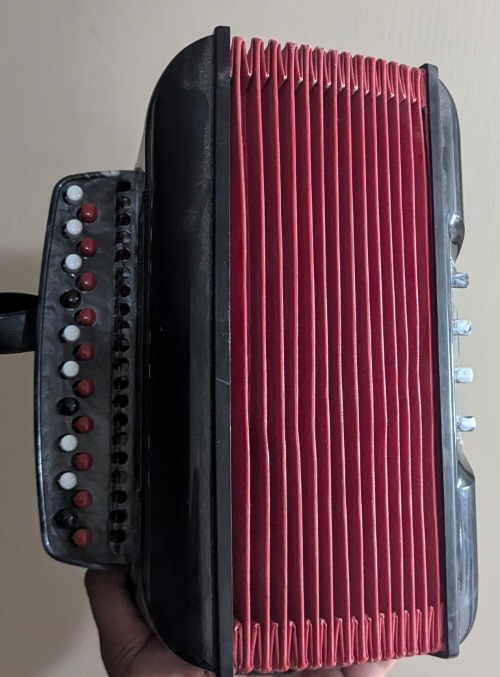
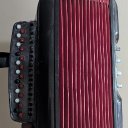
Sadly, I've been spreading myself too thin lately and I haven't been getting as much practice as I like to on a few different instruments. I have a Magnus accordion sitting on my couch that I like to play while I'm unwinding when I get off work. It's basically a vintage plastic children's toy accordion with way fewer buttons than a real one. It's a lot of fun to mess around with.
Percussion stuff. I'm playing percussion in a small concert band, and sometimes play spoons with our dulcimer group.
Whether it be a mountain dulcimer or some other musical instrument, tell us- what is your current favorite instrument that you pick up these days... and why? Tell us why it's been 'calling to you'. Feel free to attach a picture! 

Hi Dwain, pleasure to meet you. Thank you so much for all of your insight. It is all so cool! Seems like a long-lost instrument, and I would love if you added it to the registry, absolutely!
My name is Michael Lipari. Ironically enough, I bought it as-is on Facebook, just yesterday 7/23/24. The top was just kind of resting flat on the body and latched but not glued, like you said. I knew it was incomplete but I didn't know exactly how incomplete until I starting looking at more dulcimers.
It was from a woman named Michelle Bobroff Lee, who said it was a "kit" and was her grandfather's. She made some mention of Lorraine Lee Hammond as well. I forget exactly what the relation was, but I believe it was a familial connection.
I will absolutely check out your website and send a private message your way as well. Feel free to let me know if you need any other information on it, happy to help. Thank you!
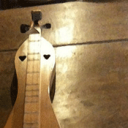
Hello everyone! This is my first post here. I’m relatively new to dulcimers but have taken a keen interest in them. I am a life-long guitar player. I had a unique opportunity to purchase this Sunhearth dulcimer and I’m looking to get it back to its working state.
I believe it is a 3-string instrument and possibly a DIY kit? The construction of it is just a bit confusing to me. It’s missing the tuning heads, nut, and bridge, and I was expecting to see nails or nail holes for loop-end strings, but there is nothing like that on it. Just a latch and one nail. The whole top part also comes off.
I set up guitars pretty regularly but I want to get some advice on this dulcimer before I buy or do anything. It seems to be in great shape and I would love to give it life again. I sincerely appreciate any and all advice / insight you can provide. Thank you for your help, looking forward to hearing from you!! :)
Hi MJ, this appears to be a Standard Teardrop, AD2. The signature is genuine Walter Martin.
How was the dulcimer supplied? Was the top separate? or did you disassemble it? It is unusual is several regards:
Unfortunately, Walt did not begin keeping a registry of his dulcimers until he had built 100, so yours is the last unregistered Sunhearth. If you like, I can add it to the registry. I'll need your name, date of acquisition, and if possible, who you acquired it from (perhaps the original owner).
You could assemble the instrument and outfit it as originally designed if you like. You may be able to find enough detail at my website, bearmeadow.com, to do that. Several people have written me over the years to say they used the info under the various menus to build their first dulcimers. But putting together a Sunhearth is essentially what is described there, and illustrated. Or send me a private message message with your email and I'll send you details.
Sounds like a plan! Ken, I will definitely take you up on that. Really appreciate it 🙏🙏 Sending you a private message now.
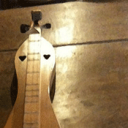
Well, my memory isn't very good. I took out my Sunhearth dulcimer and it has four strings. Here are four photos of that dulcimer. They may help you as you work on restoring yours. As you can see it has fine tuners; the black things between the saddle (bridge) and the end of the dulcimer. Also, it has three feet on the bottom as early dulcimers were meant to be played on table tops and not on laps. I'd be happy to try and answer any specific questions you have. I knew Walt Martin and visited his shop. I have two articles written about him and a Sunhearth brochure from 1974. If you send me your email address in a private message here I'd be happy to send them to you as pdfs. Just click on the link under my name and that will take you to my home page where you can click on Send A Message.
Ken
"The dulcimer sings a sweet song."
I second the suggestion to contact @dwain-wilder.
Thanks a bunch for your help Ken! Sorry about that, I used the regular iPhone photos with photo attachment function on the message template, I think they just came out too big.
I updated the post with all the photos combined into one!
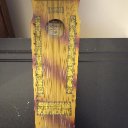
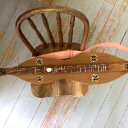
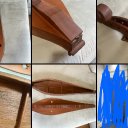
The photos you uploaded are too large to really see the instrument in question. Dwain Wilder who is a member here studied with Walt Martin who made the Sunhearth dulcimers. With good photos he should be able to answer your questions. I have a very nice Sunhearth teardrop dulcimer and I may be able to answer some questions as well. In the first photo all I can see a little bit of the top. The second photo shows the tail end and no top on the dulcimer. The third photo shows the saddle end of the fret board. It looks like there are two slots. Maybe one wasn't correct and the builder cut another slot to correct it. The fourth photo shows the strum hollow and perhaps where a slot for the saddle was going to be cut. The fifth photo shows part of the peg head. I have no idea what the sixth photo is.
Ken
"The dulcimer sings a sweet song."
Hello everyone! This is my first post here. I’m relatively new to dulcimers but have taken a keen interest in them. I am a life-long guitar player. I had a unique opportunity to purchase this Sunhearth dulcimer and I’m looking to get it back to its working state.
I believe it is a 3-string instrument and possibly a DIY kit? The construction of it is just a bit confusing to me. It’s missing the tuning heads, nut, and bridge, and I was expecting to see nails or nail holes for loop-end strings, but there is nothing like that on it. Just a latch and one nail. The whole top part also comes off.
I set up guitars pretty regularly but I want to get some advice on this dulcimer before I buy or do anything. It seems to be in great shape and I would love to give it life again. I sincerely appreciate any and all advice / insight you can provide. Thank you for your help, looking forward to hearing from you!! :)
It may be worth while to invest in a wire gauge if you need to replace strings. I have one like this which I occasional use on dulcimer strings.
I would guess that a relatively small number of sizes are required, so you might want to buy coils of wire. Otherwise Folkcraft and others probably have suitable choices, but "too long."
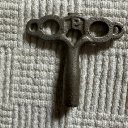
Here is a photo of the tuning wrench which came with my ukelin. I imagine a similar one was supplied with the violin uke.
Ken
"The dulcimer sings a sweet song."
I think most autoharp tuning pins today are 13/64 ths of an inch by 1.5 inches long. I have a ukelin and can check the tuning wrench that came with it to see if that is the same size. Sometimes you can substitute a t-handle tap wrench for tuning wrench depending upon how much space you have between the pins.
Ken
"The dulcimer sings a sweet song."
Made by Marx Co. yeah. It's the violin uke, not the ukelin. There's a guy with a website from the late 90's that did historical research on these things. It was quite informative. I'm not really concerned with restringing it just yet, as i need to figure out the size of the tuning pegs and get the correct tool for them. I went the autoharp route, but they don't even seem to know the size of their tuning pegs, which baffles me. I'll get some pictures up soon.
Are you referring to the instrument made by the Marx Company? It bears a strong resemblance to another of their instruments called a ukelin. The plain (unwound) strings can be replaced with plain steel guitar strings. The wound strings can be replaced with wound guitar strings. You will have a lot of string leftover. An alternative is to use autoharp strings, but it is probably more expensive. Use a micrometer to measure the thickness of the strings. As Nate said a photo of the instrument or several photos will help us better help you.
Ken
"The dulcimer sings a sweet song."
Happy along with his brother, Artie, was a great innovator in providing instruction to folk musicians. I think many of us from that era of folk music appreciated Happy's contributions to and promotion of folk music. He will be missed by family, friends, and those of us who used some of the resources he provided.
Ken
"The dulcimer sings a sweet song."
Thanks for this information, Fiona. That's one of the few issues of DPN that I don't have. It was interesting reading. I sure do miss the Whole Earth Catalog. It was fun to read and leaf through it.
Ken
"The dulcimer sings a sweet song."
I'm a little late to this chat, but I found an article in the DPN Archives on fine tuning beads that I thought might be of interest: https://archive.org/details/dpn-1975-001-07/page/n5/mode/2up
I also found John Dubroff mentioned in a publication called the Whole Earth Catalog from the 1970s, in two issues:
- https://archive.org/details/wholeearthcatalo00unse_3/page/21/mode/1up
- https://archive.org/details/updatedlastwhole00unse/page/334/mode/1up
I bought a violin uke from a friend about 2 years ago. After some research, I found this one is most likely from the 50's. I put it away and didn't think about it until I moved and hey, there it was! I think I even found someone that makes replacement strings for it but it's pretty pricey. I discovered someone on here had worked with one of these little monsters and was hoping to get some info. I've tried to find anything about the tuning pegs on this thing and can't find answers anywhere.
Can anyone help?
@dusty, Happy brought a lot of good to the world!
That's right, Robin. I forgot about Jean's Homespun lesson.
Happy's widow Jane posted a nice statement on the Homespun homepage. Apparently Happy died of pancreatic cancer.
I have Jean Ritchie's Homespun instructional cd & book and am glad I do!
RIP, Happy Traum.
To my knowledge he never played the dulcimer, but Happy Traum--along with his brother Artie--was an integral part of the folk music scene in the 1950s and 1960s in both Greenwich Village and Woodstock, NY. He hung around with Pete Seeger and then Bob Dylan and Brownie McGee and David Ronk and was a member of the interracial folk group, The New World Singers.
I never heard Happy perform, but among his accomplishments was to found Homespun Tapes, where he shared instructional material for people who wanted to learn folk music. Somewhere in my garage I have a bunch of those original cassettes, including one on fingerpicking like Mississippi John Hurt, singing harmony like Robin and Linda Williams, and two unique to Happy: one on hot acoustic licks and another on chords that taught moveable triads all over the fretboard.
Among the instructional videos Happy produced is David Schnaufer's Learning Mountain Dulcimer , still available on DVD or digital download.
After several years of concentrating on the dulcimer, I decided to go back to playing the guitar a few years ago and now have a bookmarked page on my computer for my Homespun Music's "library" of lessons. Some of the best are by Happy's kid Adam, who has continued the tradition of mastering folk music and passing on the lessons to others.
Less known than other folk musicians who achieved commercial notoriety for their recordings, Happy was nonetheless an important part of the folk music scene for about 70 years, even to those of us who never met him or heard him play in person. I learned so much from him.
Here is the Rolling Stone obituary .
I have:
All poplar Tennessee Music Box (with checkerboard on back) by John Knopf
All poplar Will Singleton by John Knopf
All poplar J E Thomas (painted black) by John Knopf
Black walnut/butternut top Boar by Bobby Ratliff
Various woods kit by Bobby Ratliff
All wormy poplar Betty by Dan Cox (came with wormy poplar coffin case)
All cherry custom by Johnny Pledger
All black walnut by Johnny Pledger
All hickory teardrop by Folkcraft
All sycamore 5-string by Bill Berg
Padauk/spruce/maple Strumstick by Bob McNally
I also have: SJ100+ Jumbo guitar by Gibson, WL-250 banjo by Gold Tone, Tackhead banjo by Eric Prust, Mountain banjo by Jon Peterson, Mountain banjo by Nate Calkins, Gourd banjo by Barry Sholder, Nickel-plated brass resophonic guitar by OMI, Copper-plated/engraved Tricone resophonic guitar by Republic, Boxcar resophonic guitar by Gretsch, Weathered steel Style-O resophonic guitar by National Resophonic, Swan concertina by McNeela, a couple of harmonicas, a kalimba, 3 Civil War era fifes, and a Civil War era tin whistle.
Whew! L think that's it!
Wow, that's an incredible collection! It sounds like you have a wide range of instruments to explore and enjoy. Do you have a favorite among them, or a go-to for certain types of music?
When you're ready to explore more tenor ukulele tabs, there are many resources available online. You can find a wide range of songs and styles on websites like Ukulele-Tabs, UkeTabs, and Ultimate-Guitar. You can also search for specific artists or songs on YouTube and find tenor ukulele covers and tutorials. Have fun exploring and playing